
What would enable marketing teams to anticipate and respond to customer needs?
Our Founder, Natasha Milsted, Chartered Marketer has recently finished her MBA Project focused on what would enable marketing teams to anticipate and respond to customer needs. Natasha is going to reflect on her findings, discussions and personal reflections on the things she heard throughout this project in a series of blogs.
This topic mattered to Marketing Moments as we are often helping our customers to understand, anticipate and respond to customer needs to support business growth or retention. Even before Natasha founded Marketing Moments, she spent a significant part of her career creating employee capabilities, pathways and processes that enabled organisations to anticipate and respond to customer needs. It is something she is extremely passionate about and wanted to take the time to explore and gain more of an in-depth understanding to why this can sometimes feel sticky.
The theoretical lens she explored this challenge under
To explore this research question and the related sub questions we framed the literature review and search around an adapted people, process and technology framework. We adapted this framework to consider some of the criticisms that resource-based theory has previously faced around not taking into account the interconnectedness of capabilities or the external environment.
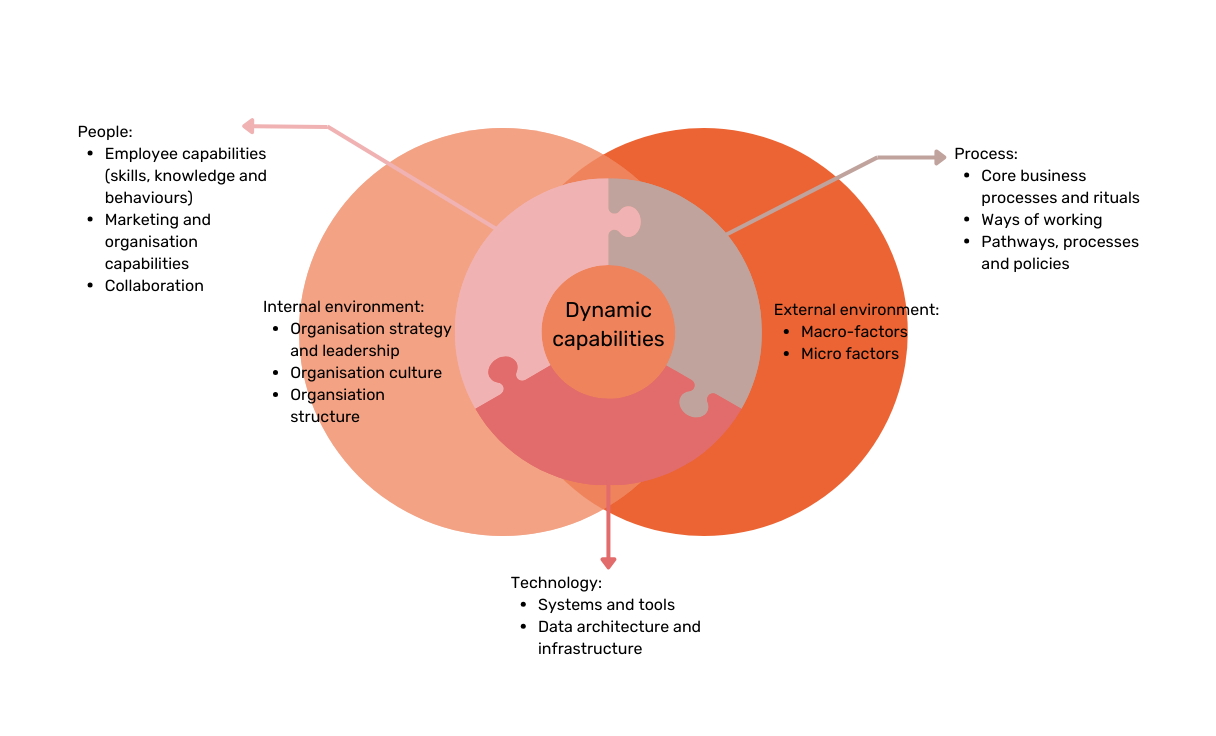
A quick definition: Dynamic capabilities are organisation capabilities associated with being able to anticipate and respond to market and customer needs. Dynamic marketing capabilities are a subset of these. This is an important point to note, as it takes more than marketing to be able to anticipate and respond to customer needs. It requires processes, pathways and organisation-wide commitment.
The primary research didn’t show a link between external environment and enablers to create dynamic capabilities. However, it did find evidence to support the other elements covered in the above figure. As a result of this research, we identified the following enablers for marketing teams:
To create the processes and pathways needed to anticipate and respond to customer needs, marketing leaders should be able to mediate, facilitate and influence.
Marketing team members need to be confident, collaborative and have a curiosity mindset.
Organisation capabilities that enable the creation of dynamic capabilities include learning, transformation and change capabilities.
Knowledge-sharing processes need to exist and are underpinned by collaborative processes and behaviours.
Knowledge-sharing cultures are an enabler to anticipating and responding to customer needs with three key characteristics: everyone understands the importance of knowledge-sharing; knowledge-sharing is embedded in organisation strategy and vision; and leaders promote and celebrate collaboration and knowledge-sharing.
There is a wealth of data, insight and yummy things to share from the ten in-depth interviews we did. Too many to cover in one blog. This is why over the next couple of months we are going to do a series of blogs and explore these enablers in more depth. We will also be holding two roundtable events. One for participants that took part in the research and another for people interested in the topic. We will post more details about this once we have firmed up the date.
Worried you’re going to miss an update? Not to worry you can subscribe to our newsletter (see footer) and will send you updates straight to your inbox.


Discover how shared KPIs across marketing, sales and operations reduce silos, improve collaboration and strengthen customer experience. Includes practical guidance, lived experience and a proven cross‑functional KPI framework.